
How to Combine Furniture from Different Eras Without Losing Design Coherence
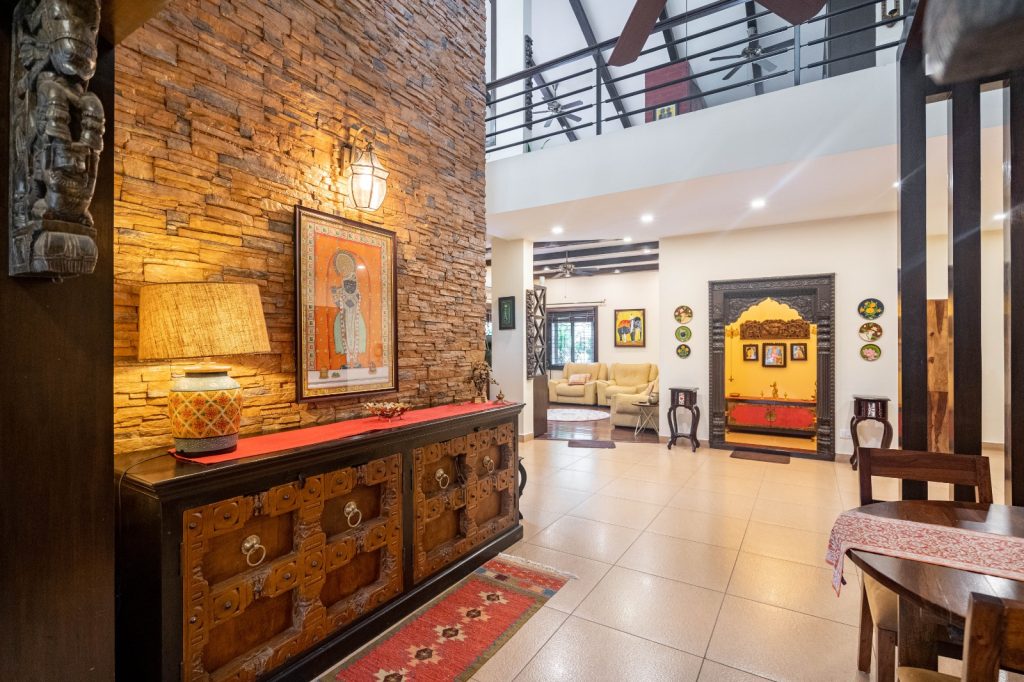
Table of Contents
ToggleEvery family has that one piece. The carved cabinet that has always held the good crockery, or the chairs everyone has sat on for years. They carry memories, and that’s exactly why people hesitate to bring them into a new home.
We faced this recently in a living room, where a traditional carved crockery unit and a set of dhokra chairs were the pieces our clients most wanted to keep. Here is how we made them feel at home in a modern space, and what it taught us about mixing eras.
We hear some version of this nearly every month at Cee Bee Design Studio. And every time, our answer is the same: mixing eras is not the risk. Mixing them without a plan is.
Here’s how we think about it.
Find the thread first
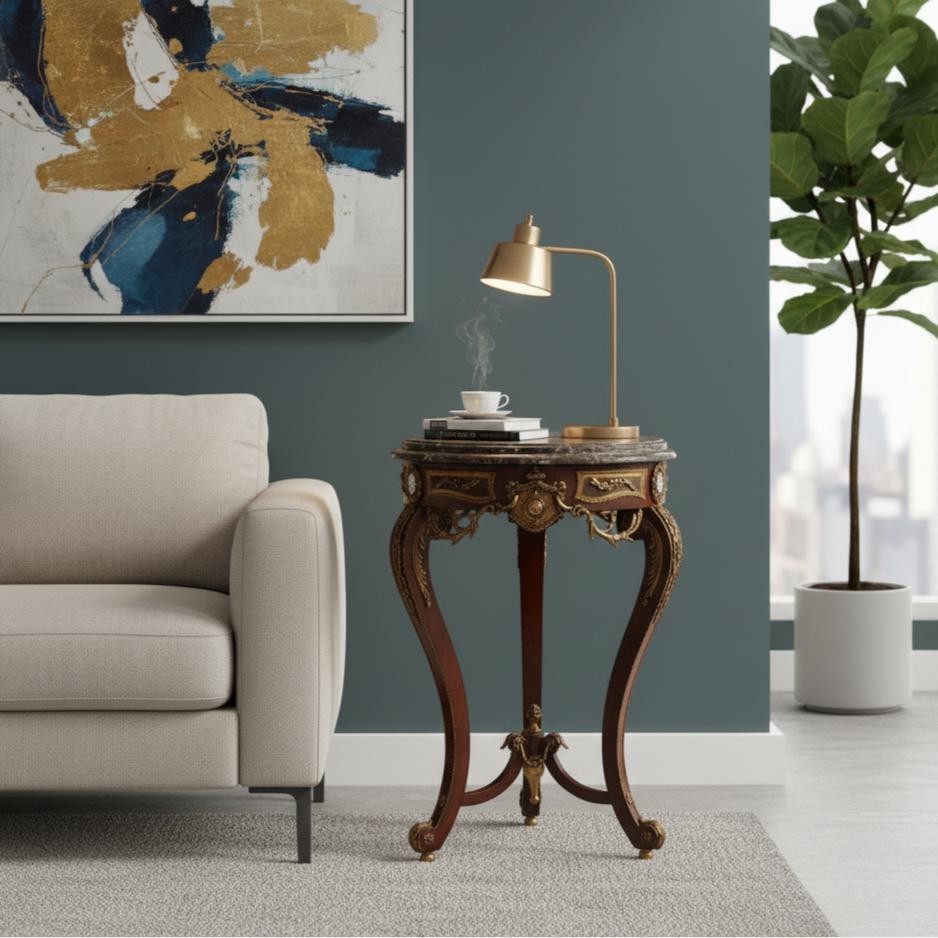
Before we place a single piece, we look for what quietly connects everything. It might be a colour, a material, a curve, or simply a feeling. A Victorian settee and a very plain modern side table can sit together happily if both have the same warm walnut tone, or the same softness in their lines.
In our villa projects across Kolkata, we usually start with what clients already own and ask, “What do these things have in common?” There is almost always something. Our job is to make it visible.
Choose new upholstery as a bridge
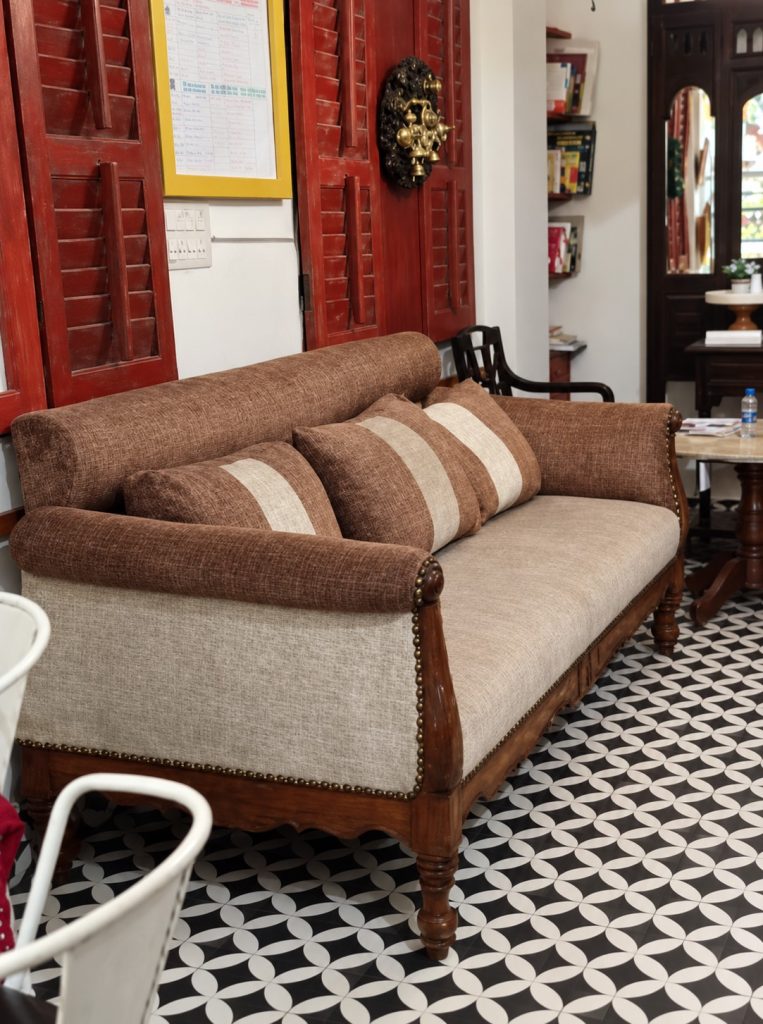
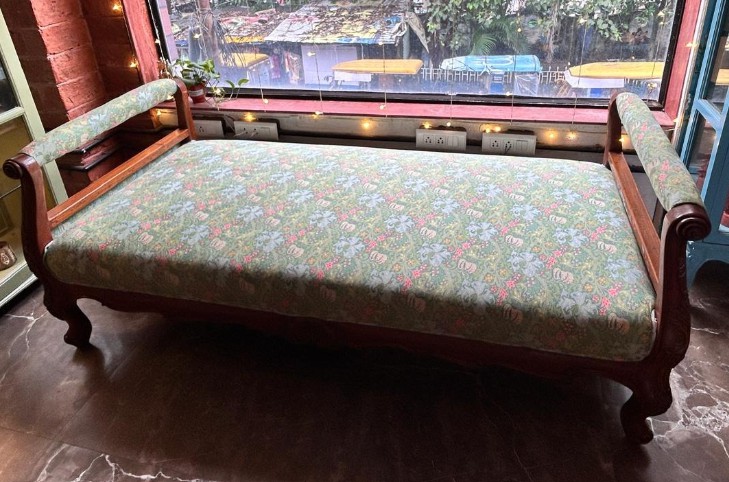
Upholstery is one of the most useful tools for mixing eras. A heritage frame with a new, well-chosen fabric instantly feels at home in a contemporary room. For the divan, we picked fabric and refurbished the divan and made it blend with the overall look of the room. The old and new pieces now speak to each other instead of competing.
Pay attention to weight, not age
The date a piece was made matters far less than how heavy it looks. Old furniture tends to be solid, dark and substantial, so the real question is how to give it company that holds its own without competing.
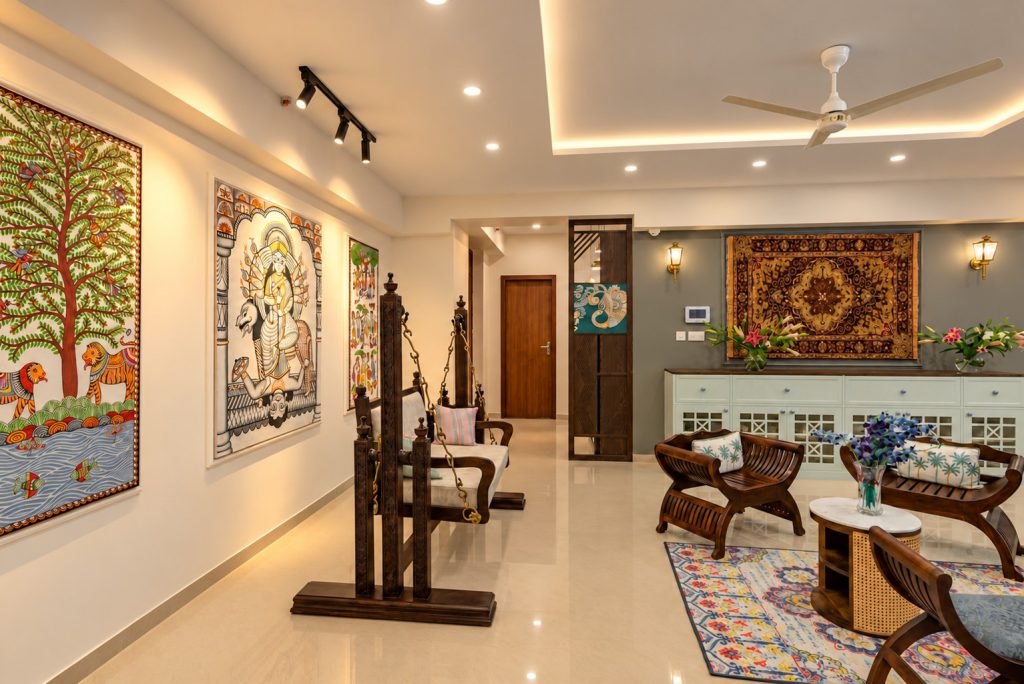
This living area is a good example. The carved wooden swing is the heaviest thing in the room, with tall posts, deep carving and dark timber. Left in a cramped, busy space, it would have swallowed everything around it. So we did the opposite. We gave it generous floor space, set it against calm cream walls, and let the open frame and the chains do the work of keeping it light. It reads as a statement, not an obstruction.
The old wooden chairs, with their curved arms and low stance, share the swing’s warm wood tone, which quietly links the two across the room. Then we balanced that weight on purpose. A cane and marble side table sits between the chairs, lighter in material and finish, and the pale mint console with its lattice doors gives the far wall a soft counterweight. Dark, heavy pieces on one side meet light, airy ones on the other, and neither side wins.
Height does the rest. The swing rises tall, the chairs sit low, the console stays long and level, and the large artworks lift the eye back up the walls. A room where everything sits at the same height feels flat, and this one moves.
The takeaway: it was never about whether the pieces were old or new. It was about giving each one the right amount of space, the right neighbour and the right contrast.
Keep the colours quiet and let textures talk
When furniture comes from different decades, colour is the easiest way to calm things down. We usually hold a room to three or four tones, then let texture do the work.
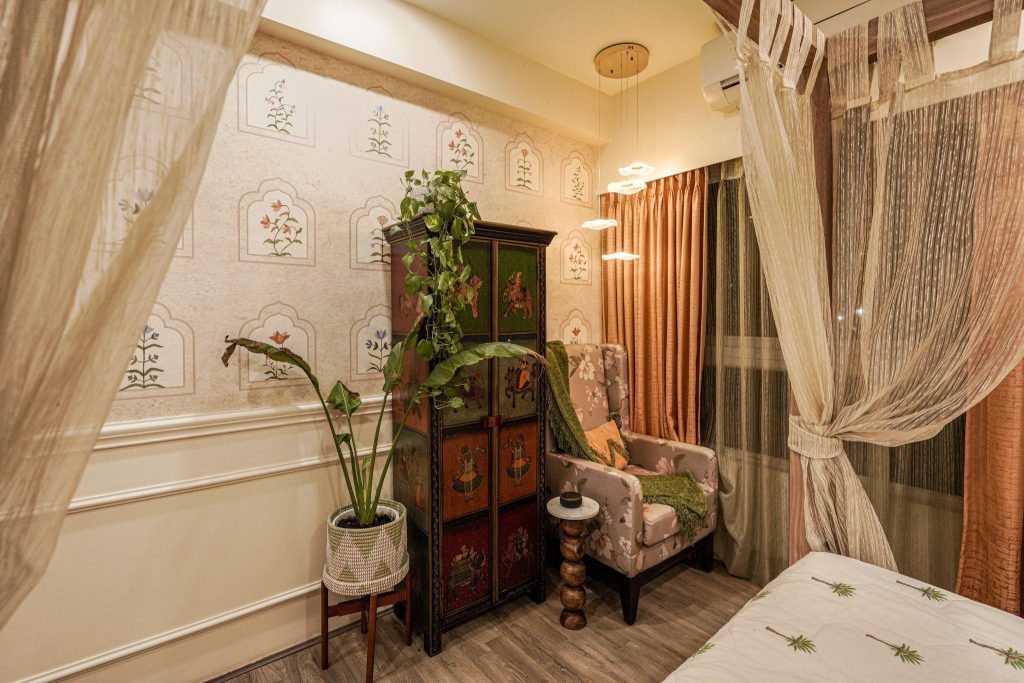
This bedroom corner shows how well it works. The palette is deliberately small: warm cream on the walls, soft terracotta in the curtains, and sage green in the throw, the plant and the painted panels of the cabinet. That is really all the colour the room has.
The interest comes from everything you can touch. Sheer, loosely woven curtains filter the light. A floral wingback chair brings softness and pattern. A turned wooden side table adds a sculptural note, and a woven planter adds a handmade one. Below the delicate arched motifs on the wall, the simple panelling gives the whole corner a calm base.
The hand-painted cabinet is the oldest voice here, and it holds its own. It sits comfortably with the chair and the curtains because it shares their colours, and the colours do the introducing. The painted figures, the florals on the chair and the arched motifs on the wall also echo each other quietly, so the eye moves around the corner instead of stopping at any one piece.
A restrained palette lets craftsmanship speak. When the colours agree, the textures and the eras no longer have to.
Let one era lead
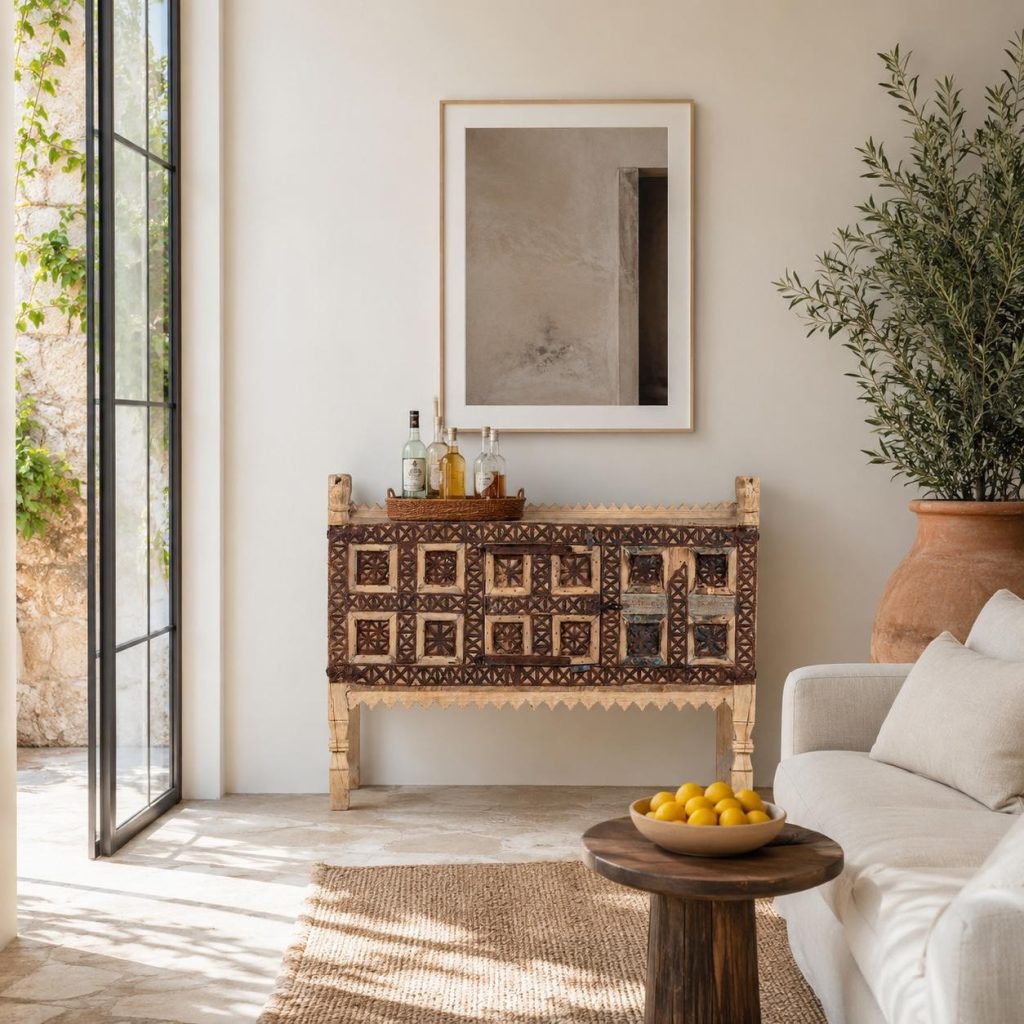
We often use a rough 70/30 split. Let one period set the tone, say contemporary, and let the others show up as accents. A modern living room with one beautifully restored carved chest or a single antique Bengali daaji chair looks curated. Equal parts of everything looks confused. The eye needs somewhere to rest.
The one old piece should also feel chosen, not like something you couldn’t bear to throw out.
Repeat yourself, a little
This is a small trick that makes a big difference. If you have a vintage table with brass inlay, bring that brass back in a lamp base, a picture frame, or the cabinet handles across the room. If a mid-century chair has tapered legs, look for those legs again in a stool or console.
Nobody walking in will say, “Ah, repetition.” They’ll just feel that the room makes sense.
Give the furniture a good stage
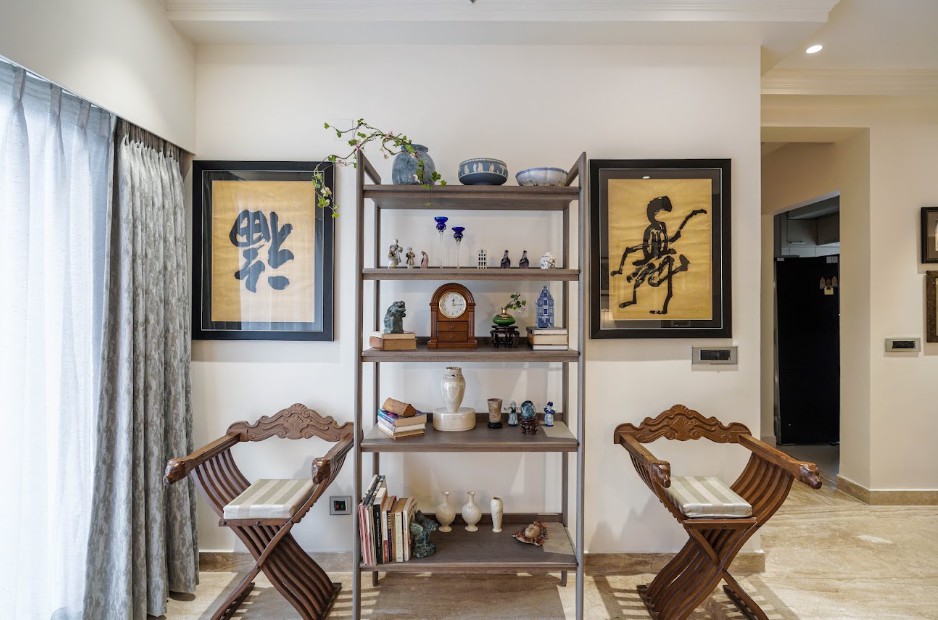
Plain, calm walls and thoughtful lighting do more for mixed-era rooms than most people realise. This corner is a good example of why.
The wall is a soft, warm cream with nothing competing for attention: no pattern, no heavy panelling, just clean surfaces and a simple cornice above. Against that quiet backdrop, every piece gets room to be seen. The pair of carved wooden folding chairs, with their sculpted arms and fretwork, would feel busy in a crowded setting. Here they read as small works of craft, framed by space on either side.
Notice how the composition is built on symmetry. The chairs sit as a matched pair on either side of a slim, open shelving unit, and two framed pieces of calligraphy-style art hang at the same height above them. That repetition gives the corner a calm, ordered rhythm, which lets very different objects share one wall without confusion. Old chairs, a clean contemporary shelf, a vintage clock, small ceramics and books all sit comfortably together because the arrangement around them is disciplined.
The soft pinstripe cushions on the chairs act as a gentle bridge. Light and simple, they tie the carved wood to the pale walls and the sheer curtains beside them.
Lighting finishes the job. Daylight filtering through the sheers lays a soft glow across the floor and the chairs, and subtle recessed lighting overhead keeps the wall evenly lit without harsh shadows. In our villa projects, we layer ambient, task and accent light to do the same thing: soften the contrast between pieces and give the whole room one warm glow. It is the simplest way we know to make different things feel like they belong together.
Edit, then edit again
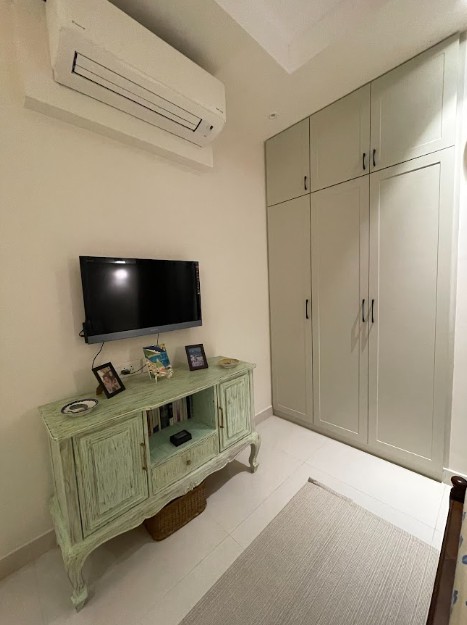
This is the hard part, and we say it with love. Not every piece you adore belongs in every room. One heirloom in the right place will always look better than three in the wrong one.
We sometimes ask clients to try a simple test. If adding something weakens the story of the room, it’s not wrong; it’s just in the wrong room. Maybe it belongs in the study, or in the guest bedroom, or waiting for the next house.
The mistakes we see most
Buying everything from one showroom is the big one. Matching sets look tidy but feel flat, and a little tension is healthy. The second is ignoring wood tones. Too many different finishes with no shared undertone creates noise. Then there’s treating antiques like museum pieces. Use them! A vintage trunk makes a lovely coffee table. And finally, skipping the plan. A collected-looking room is never accidental. It still needs a floor plan, a palette and a point of view.
How we work at Cee Bee
Cee Bee Design Studio is a team of premium villa interior designers in Kolkata, and every project begins with listening. We’ve learned that the best homes aren’t defined by a style label but by the people living in them.
So we sit with you, look at what you own and love, and build a design language where the past and the present can share a room comfortably.
Whether it’s a heritage house in North Kolkata or a brand-new villa, we think of furniture as part of a longer story. Every era gets a voice. None of them gets to shout.
One last thought
Mixing eras is not about breaking rules. It’s about knowing which ones to bend. Find your thread, respect proportion, keep the palette disciplined, and edit with confidence, and your home will feel timeless rather than themed. If you have pieces you love and no idea how they’ll live together, we’d be glad to help. At Cee Bee Design Studio, we design homes that feel layered, personal and entirely yours.
Get in touch to start your design journey.
Follow us on:
About us
Welcome to CeeBeeDesignStudio, an Indian homegrown interior design brand where every home is a canvas and every design is a story.
We’ve proudly completed over 1000 residential and 400 commercial projects across 7 cities, earning a reputation for unmatched aesthetic acumen and client satisfaction. Our studio has also been recognized with multiple national awards, a reflection of our commitment to excellence, storytelling, and design innovation.
From thoughtfully styling modern apartments to restoring heritage homes, we bring soul, sustainability, and structure into every project.
Enter Your Details